Quick answer: If you have a flat tire and no spare, stop in a safe place and do not keep driving on the damaged tire. Depending on the damage, a mobile technician may be able to repair the tire or bring a compatible replacement to your location. Towing is still the right choice when the vehicle is unsafe to service where it stopped or there is additional wheel, suspension, or accident damage.
Many drivers only discover that their vehicle does not have a spare after the tire is already flat. Some vehicles come with a sealant and inflator kit, some use run-flat tires, and others leave the spare-tire area empty to reduce weight and create more cargo or battery space. Whatever the reason, you still have practical options.
Move away from traffic if the vehicle can be moved safely
Turn on the hazard lights, slow down gradually, and look for a level parking lot, side street, exit ramp, or wide shoulder. Avoid stopping on a curve, close to an intersection, or anywhere another driver may not see you.
If the tire is fully flat, separated, or coming off the wheel, do not drive farther than needed to escape immediate danger. Continuing to drive can damage the wheel and may turn a tire problem into a more expensive repair. If the vehicle is already in a protected location, leave it parked.
Confirm what your vehicle actually carries
Check beneath the cargo floor, behind the side panels, or under the vehicle if the owner's manual shows an exterior spare location. Look for a temporary spare, jack kit, inflator, sealant container, wheel-lock key, or towing eye.
If your vehicle has a mobility kit, read the instructions before using it. A sealant kit is not the answer for every flat. Sidewall damage, a blowout, a large cut, a tire separated from the wheel, or damage caused by driving while flat may require replacement. Using sealant can also affect how the tire is inspected later, so tell the technician if any product was added.
Option one: repair the tire when the puncture is eligible
A small puncture in the main tread area may be repairable after the tire is removed and inspected. The U.S. Tire Manufacturers Association recommends repair only when the damage is limited to the tread area and the puncture is no larger than 1/4 inch. It also states that a plug alone is not an acceptable permanent repair.
Sidewall and shoulder damage should not be treated like a simple tread puncture. The tire may also need replacement when it has exposed cords, unsafe tread, multiple nearby punctures, or internal damage from being driven flat.
Amp Rescue provides mobile tire patching when the damage can be repaired safely. The final decision requires an inspection, not just a photo or a guess from the driver's seat.
Option two: bring a replacement tire to the vehicle
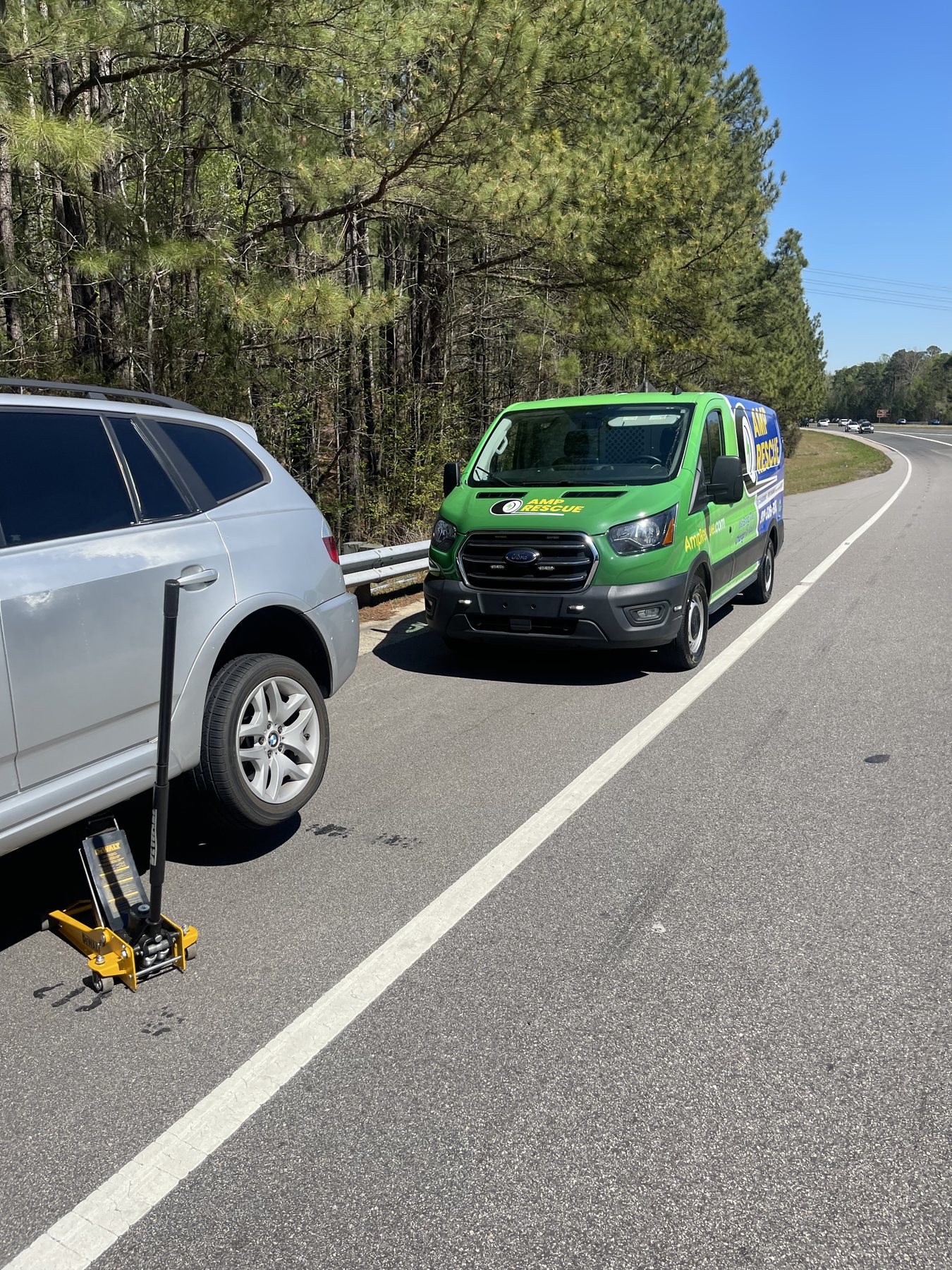
If the tire cannot be patched and there is no usable spare, mobile tire replacement may keep the vehicle from needing a tow. Amp Rescue can help source, deliver, and install a compatible replacement tire at your location when available.
Availability depends on the tire size and the details of the vehicle. Common passenger-vehicle sizes may be easier to source quickly, while uncommon sizes, specialty tires, and certain performance or commercial applications can take longer.
Before dispatch, send the vehicle year, make, and model along with a clear photo of the damaged tire and the size printed on its sidewall. The National Highway Traffic Safety Administration also recommends checking the driver's door placard or owner's manual for the correct tire size and pressure information.
Option three: tow the vehicle when mobile service is not safe
Mobile tire service is useful, but it is not the right answer for every roadside situation. Towing may be necessary when the vehicle is in an active traffic lane, the shoulder is too narrow, the wheel is bent, the suspension or brakes are damaged, or the flat happened during a collision.
Tell dispatch immediately if the vehicle is leaning, leaking fluid, making contact with the road, or cannot be moved out of danger. The safest next step matters more than forcing an on-site repair.
What to send Amp Rescue
Clear information helps us determine the right service before a technician is dispatched. Send your exact location, vehicle year, make and model, tire size if visible, which tire is damaged, and whether the vehicle is in a safe place. Include one photo showing the full wheel and another close photo of the damaged area when possible.
If you used tire sealant, drove on the tire after it lost air, struck a pothole, or heard a blowout, mention that too. Those details can change whether a patch, replacement, spare installation, or tow is appropriate.
How to prepare before the next flat
Check the tire compartment now, before you need it. If your vehicle has a spare, check its pressure along with the other tires. NHTSA notes that spare tires age and should be inspected even though they are rarely used. If the vehicle has an inflator kit, confirm that the sealant has not expired and that you know where the power connection is.
Save Amp Rescue's number, (919) 526-5165, and keep the wheel-lock key where a technician can find it. A few minutes of preparation at home can remove a lot of uncertainty from a roadside call.
Common no-spare questions
Can Amp Rescue bring me a new tire?
Amp Rescue can help source, deliver, and install a compatible replacement tire when available. Send the tire size, vehicle details, location, and photos so availability can be confirmed before dispatch.
Can I drive slowly on the flat tire?
Do not continue driving on a visibly flat or damaged tire except when movement is necessary to leave immediate danger. Even a short distance can damage the tire internally or damage the wheel.
Does every flat tire need replacement?
No. Some small tread punctures are repairable after inspection. Sidewall damage, blowouts, large punctures, unsafe wear, and damage from driving while flat often require replacement.
Flat tire with no spare right now?
Call Amp Rescue at (919) 526-5165 or text us. We provide mobile tire patching, tire change service, replacement assistance, and roadside help across Raleigh, Durham, Cary, Wake Forest, Garner, Knightdale, Rolesville, Youngsville, and nearby Triangle communities.