
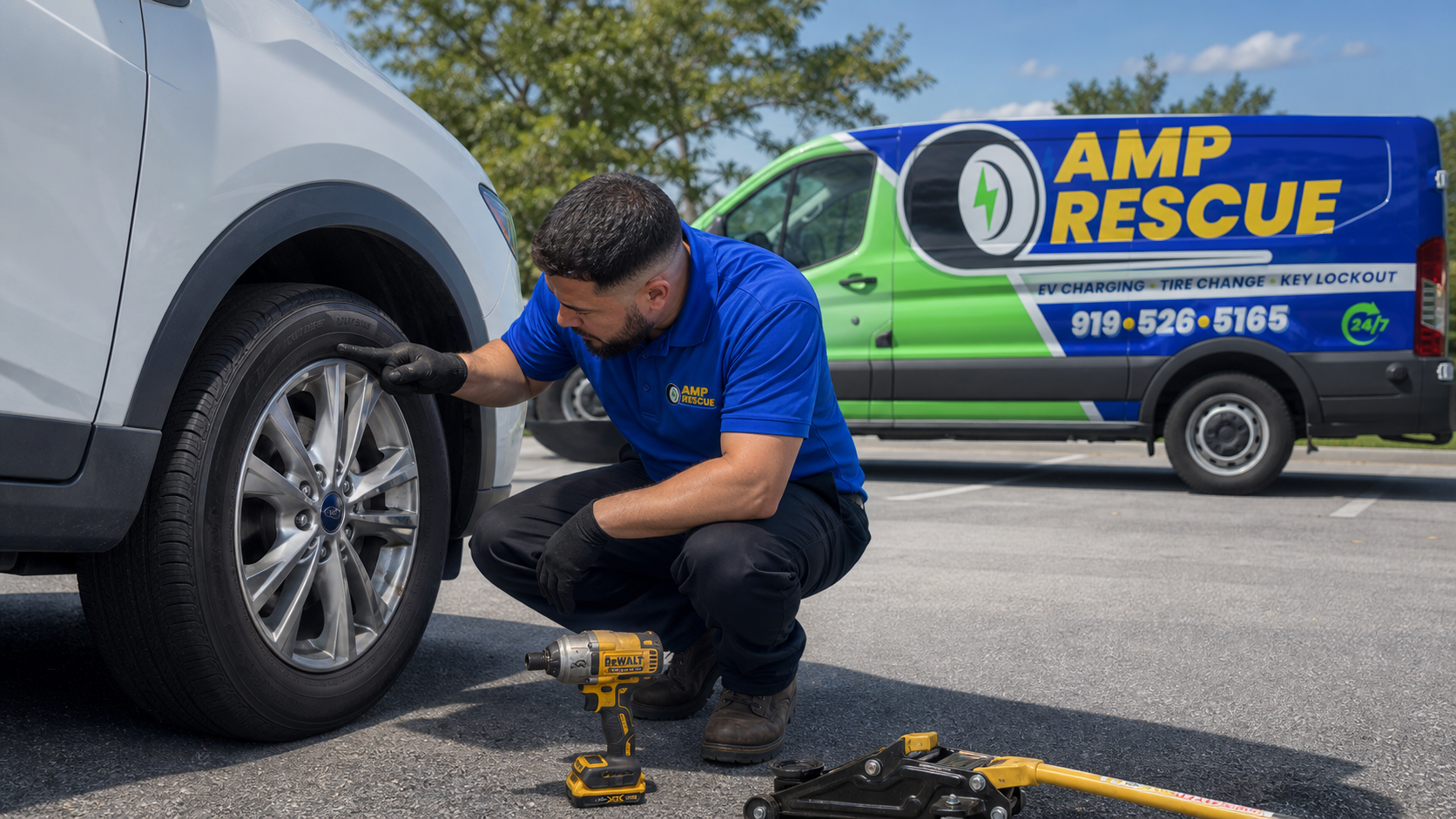
Quick answer: Look for a code such as 225/55R17 on the tire sidewall, then check the Tire and Loading Information label inside the driver's door opening. Send Amp Rescue a clear photo of both before requesting mobile tire replacement. The complete code matters: tires with the same wheel diameter can have different widths, sidewall heights, load ratings, and fitment requirements.
Finding the size before dispatch helps confirm whether a suitable replacement is available and avoids bringing a tire that will not fit your vehicle.
Where to find the tire size
The fastest place to look is the sidewall of an undamaged tire currently mounted on the vehicle. The size appears as a group of letters and numbers, commonly in a format such as 225/55R17 97H. Take a straight, well-lit photo that shows the entire line.
Next, open the driver's door and find the Tire and Loading Information label on the door pillar or door frame. It lists the vehicle manufacturer's recommended tire size and cold inflation pressure. NHTSA directs drivers to this label or the owner's manual for the manufacturer's pressure specification.
If the sidewall and door label show different sizes, send photos of both. The vehicle may have aftermarket wheels, a staggered setup with different front and rear sizes, or a tire that does not match the original specification. Dispatch should not guess which one applies.
How to read a code such as 225/55R17
In 225/55R17:
- 225 is the nominal tire width in millimeters.
- 55 is the aspect ratio: the sidewall height is 55 percent of the tire's width.
- R identifies radial construction.
- 17 is the wheel diameter in inches.
Characters after the size, such as 97H, identify the load index and speed rating. Prefixes and suffixes can also matter. Send the whole line rather than only saying “17-inch tire.” A wheel diameter by itself is not enough to identify a replacement.
Which tire should you photograph?
If the damaged tire's markings are readable, photograph that tire first. If the sidewall is shredded, folded under the wheel, or facing traffic, do not put yourself in danger to reach it. Photograph the matching tire on the same axle from a safe position and include the driver's-door label.
Some vehicles use different sizes on the front and rear axles. Do not assume the opposite corner is the same size. The label, owner's manual, and markings on the same axle provide better information.
What else to send before requesting mobile replacement
Along with the tire-size photos, send:
- Vehicle year, make, model, and trim when known
- Exact address or a shared map pin
- Which tire is damaged: driver or passenger side, front or rear
- A photo showing the damage and the wheel
- Whether the vehicle has a usable spare
- Any wheel lock key, unusual lug hardware, gate code, or parking-deck restriction
- Whether the vehicle is safely away from moving traffic
A photo of the damage helps distinguish a possible tread-area puncture from sidewall damage, a blowout, or a tire that was driven while flat. The final service decision must be based on the tire's actual condition, not the photo alone.
Tire change, patch, or replacement?
A mobile tire change uses the vehicle's usable spare. A tire patching service may be appropriate for certain repairable punctures in the tread area. A mobile tire replacement is generally the relevant service when there is sidewall damage, a blowout, severe structural damage, or no usable spare.
Not every flat tire can be repaired, and a matching size does not automatically make every tire suitable for every vehicle. Availability, load requirements, vehicle configuration, wheel condition, and the extent of the damage all need to be confirmed.
What not to use as the tire size
Do not send only the maximum pressure molded into the sidewall. That is not the vehicle manufacturer's recommended inflation pressure. Also avoid relying only on an old receipt, an online tire finder, or the vehicle model name when a clear label or sidewall photo is available. Trim levels and wheel packages can change the required size.
The DOT Tire Identification Number is useful for identifying when and where a tire was made, including recall research, but it is not a substitute for the size code. USTMA explains that the Tire Identification Number is a separate set of letters and numbers on the sidewall.
Mobile tire replacement in Raleigh and nearby areas
Amp Rescue provides mobile tire service at safe, accessible locations across Raleigh, North Raleigh, Wake Forest, Durham, Cary, Morrisville, Knightdale, Rolesville, Youngsville, and nearby Triangle communities.
Traffic, tire availability, technician availability, weather, and site access affect service timing. Dispatch confirms the available service, price, and expected timing before sending a technician.
Common tire-size questions
Can Amp Rescue identify my tire from the VIN?
The VIN and vehicle details can help, but they may not reveal aftermarket wheels or a changed tire setup. Sidewall and driver's-door-label photos provide important confirmation.
Is the tire size the same as the wheel size?
No. The wheel diameter is only one part of the tire-size code. Width, aspect ratio, construction, load requirements, and other markings also matter.
What if the front and rear tires are different sizes?
Send photos from both axles and identify exactly which tire is damaged. Some vehicles are designed with different front and rear sizes.
Can I use the number printed next to “MAX PRESS”?
No. That number is the tire's maximum pressure, not its size and not the vehicle manufacturer's recommended operating pressure. Use the size code and check the driver's-door label for recommended cold pressure.
What if I cannot safely reach the damaged tire?
Stay away from moving traffic. Send the vehicle information, location, door-label photo, and a safe photo of the matching tire on the same axle if possible. Safety comes before collecting every detail.
Need a replacement tire brought to your vehicle?
Call Amp Rescue at (919) 526-5165 or text us with your location, vehicle information, tire-size photos, and a picture of the damage. Dispatch will confirm the correct service and available tire before sending a technician.