
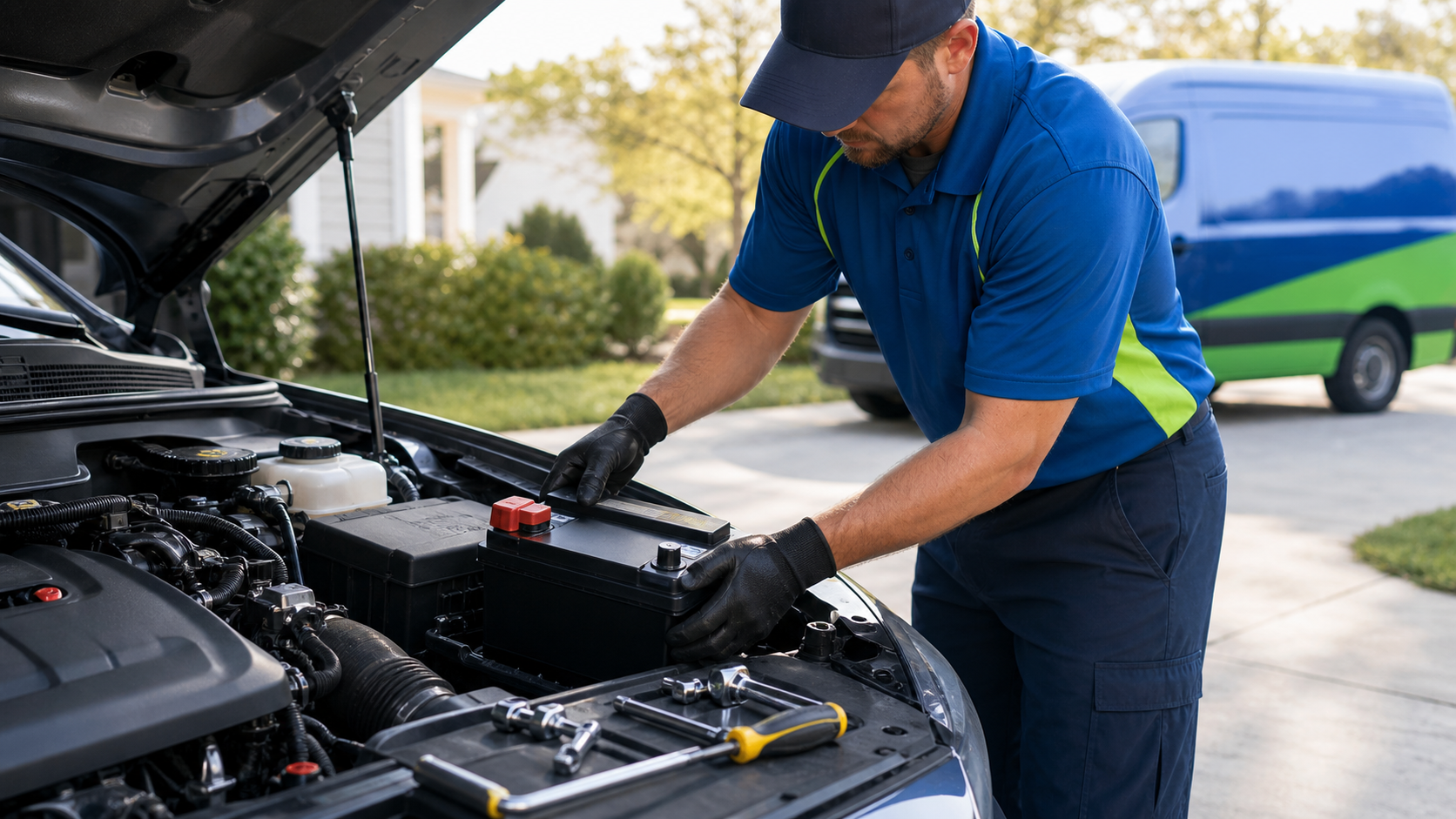
Quick answer: A jump start may be enough when a healthy battery was drained once by lights, accessories, or a vehicle sitting unused. Battery replacement is more likely when the car needs repeated jumps, cranks slowly, or will not hold a charge after it starts. If the lights are bright but the engine does not crank normally, or the vehicle starts and then dies again, the problem may involve the starter, alternator, wiring, or another system that needs mechanical diagnosis.
The sound the vehicle makes, what happened before it stopped starting, and what happens after a jump can help narrow down the next step. A proper battery and charging-system test is still the best way to confirm the cause.
When a jump start may be enough
A jump start supplies enough outside power to start a vehicle with a discharged 12-volt battery. It can make sense after an interior light was left on, the vehicle sat unused, or an accessory drained the battery while the engine was off.
Listen and look for common low-voltage clues: rapid clicking, dim interior lights, weak dashboard lights, or an engine that turns over slowly. These signs can point toward a discharged or weak battery, but they do not prove that the battery is the only problem.
If the vehicle starts, do not assume the issue is permanently solved. Arrange a battery and charging-system test, especially if the battery has needed more than one jump. AAA lists repeated jump starts, slow cranking, dim lights, electrical trouble, and a swollen or foul-smelling battery among signs that warrant attention.
When the battery probably needs replacement
A battery that repeatedly loses its charge may no longer store enough energy for reliable starting. Replacement is also more likely when a battery test shows poor condition or when the battery has visible damage.
Do not attempt to jump a battery that is cracked, leaking, badly swollen, frozen, or giving off a strong rotten-egg smell. Keep sparks and flames away from the battery and have the vehicle assessed safely. AAA advises replacing a damaged battery rather than trying to jump it.
A correct replacement must match the vehicle's specifications, including battery type, group size, terminal layout, and required capacity. Some vehicles also have model-specific replacement or electronic reset procedures. Check the owner's manual or service information before installing a battery.
Signs the problem may be somewhere else
A no-start condition is not always a dead battery. A single heavy click with bright lights can point toward a starter problem. An engine that cranks at normal speed but does not start may have a fuel, ignition, sensor, or mechanical issue. A vehicle that starts with a jump and then shuts off again may have a charging-system problem.
Amp Rescue provides mobile jump starts and battery replacement, but it does not perform general mechanical repairs. If testing or the vehicle's symptoms point to the starter, alternator, wiring, or another system, the next step may be a repair shop or tow rather than another battery service.
What to tell dispatch before battery service
Send the vehicle year, make, model, exact location, and a short description of what happens when you try to start it. Mention whether the lights work, whether you hear rapid clicks or one click, whether the engine cranks, and whether the vehicle has already been jump-started recently.
Photos of the battery label and engine compartment can help confirm compatibility before dispatch. Tell Amp Rescue if the vehicle is in a parking deck, gated community, underground garage, or another location with access or height restrictions.
Mobile battery help across the NC Triangle
Amp Rescue provides mobile jump-start service and battery replacement at your location. Service is available at homes, workplaces, parking areas, and other safe, accessible locations across Raleigh, Durham, Cary, Wake Forest, and nearby Triangle communities.
Typical arrival is 20 to 45 minutes, depending on location, traffic, technician availability, weather, and current call volume. Dispatch confirms the service, timing, compatibility, and price before sending a technician.
Stay safe while you wait
If the vehicle is stopped near moving traffic, turn on the hazard lights and move to a protected location when it is safe. NHTSA advises approaching drivers to move over or slow down for stopped vehicles displaying flashing lights. Call 911 if the vehicle is blocking an active lane or anyone is in immediate danger.
Do not stand between vehicles during a jump start, lean over a damaged battery, or allow clamps and tools to contact the wrong terminals. If the location does not leave enough room to work safely, arrange to move or tow the vehicle.
Common battery-service questions
Will a jump start fix a bad battery?
A jump may start the engine, but it cannot restore a battery that no longer holds a reliable charge. If the car needs another jump soon afterward, have the battery and charging system tested.
Can Amp Rescue replace the battery at my home or workplace?
Yes, when a compatible battery is available and the vehicle is in a safe, accessible place. Send the year, make, model, and battery information so compatibility can be checked before dispatch.
What if the car still will not start after a jump?
Stop repeated attempts and have the vehicle assessed. A failed battery, poor connection, starter problem, alternator issue, wiring fault, or another mechanical condition may be responsible.
Car will not start right now?
Call Amp Rescue at (919) 526-5165 or text us with your vehicle details, location, and symptoms. Dispatch will help determine whether a jump start, battery replacement, or another next step makes sense.