When your EV is too low to reach a charging station, AMP Rescue's mobile EV charging service may be able to bring the charge to you. We first check your vehicle and location, then confirm availability, timing, and price before dispatch.
The aim is to help a compatible EV reach its next charging stop. Whether that is possible depends on the vehicle's condition, the charging equipment available, and a safe place to work.
The call starts with your vehicle and location
Have these details ready when you call:
- Your EV's year, make, and model.
- Remaining battery percentage or displayed range, plus any dashboard warning.
- The exact parking location, including the entrance, level, or gate instructions.
- Whether the vehicle can still move and whether it has accepted a charge recently.
A map pin is useful in an apartment complex, shopping center, or large office lot. Add a landmark or entrance description so the technician can find the vehicle. Take a photo of the dashboard message if you can do so safely; its exact wording is more useful than saying the battery is dead.
We confirm the service before sending a technician
The model and charging connection help us check compatibility. The location tells us whether we can reach the EV and work beside it safely. Mention a parking-deck height limit, a locked gate, tight parking, or any other access restriction during the call.
Before approving the visit, confirm the quoted price, expected arrival, and what charging support is available for your vehicle. Arrival time and charging time are separate parts of the visit. If your location or the vehicle's condition changes while you wait, let dispatch know.
What happens at the vehicle
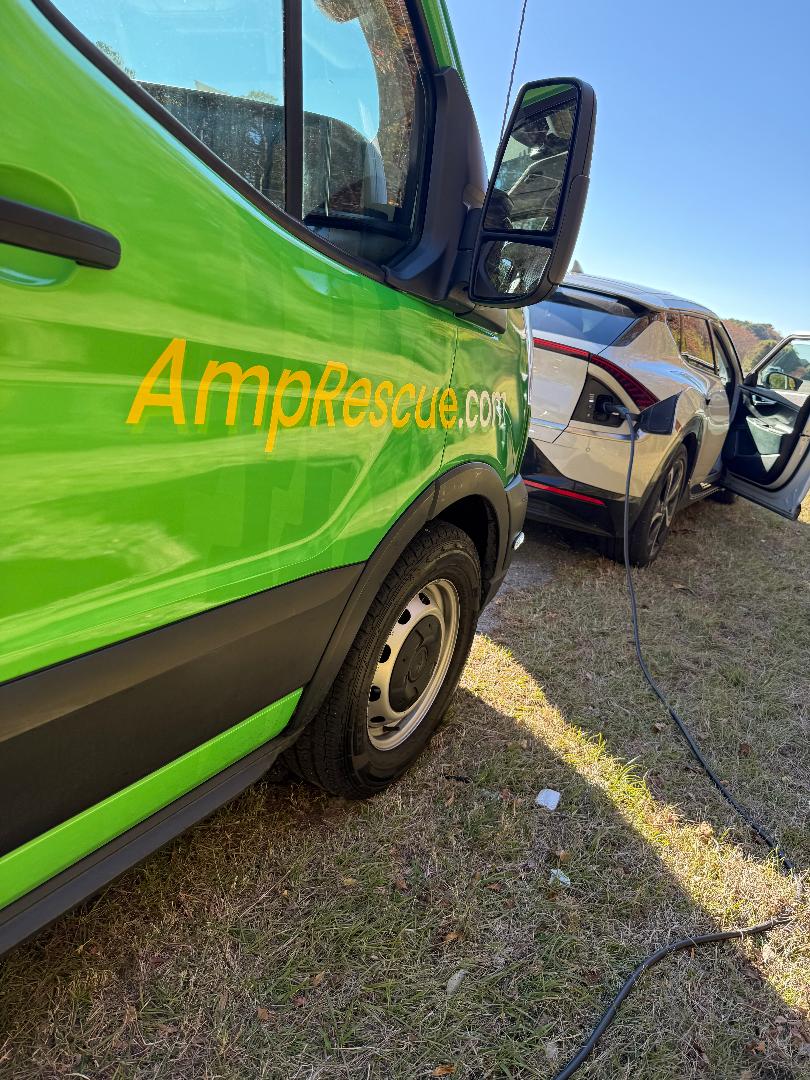
For a suitable vehicle in a safe, accessible location, the technician brings compatible charging equipment to the EV and connects it for charging. The vehicle must be able to accept that charge. If it will not, adding energy may not be the right solution.
Keep the charge-port area accessible, and follow the technician's directions around the equipment. You do not need to open battery covers or handle high-voltage components to prepare for the visit.
Mobile service can be considered at a home, workplace, apartment parking area, or safe roadside location. A location being on the service map does not mean every parking space or roadside shoulder is suitable; access still needs to be checked.
How much charge should you expect?
Discuss the next reachable, compatible charging station before agreeing to service. A roadside charge is intended to help you reach a charging stop, rather than promise a full battery or a fixed number of miles.
The U.S. Department of Energy explains that charging time depends on the battery's state of charge, its capacity, the vehicle's charging capability, and the charging equipment. A charging-rate figure for a public fast charger should not be treated as the rate of a mobile service.
Ask what the available equipment can provide for your particular EV and situation. There is no single time or mileage figure that accurately describes every visit.
Plan the next stop before driving away
Use the vehicle navigation system or the charging network's app to check the destination's connector, current availability, and access hours. Check the driving route as well as the distance: a station that looks close on the map may require a longer trip by road.
Compare the vehicle's updated charge and range estimate with that route, leaving a margin for conditions rather than planning to arrive at zero. If you cannot confidently reach a suitable station, discuss the next step before leaving.
When mobile charging is not the right service
Charging cannot repair collision damage, a high-voltage fault, or a vehicle that will not accept energy. An EV blocking traffic or parked where safe access is impossible may need a tow instead. Tell dispatch about warning messages, damage, or flooding before a visit is arranged.
NHTSA warns that damaged EV batteries can create shock and fire hazards. Do not touch exposed wiring or high-voltage components. Move away and call 911 if there is immediate danger. A towing provider should follow the transport procedure for the specific vehicle.
Common questions
Can I call before the battery reaches zero?
Yes. Call when the remaining range may not be enough to reach a suitable charger. You do not need to wait until the vehicle stops moving to ask about mobile charging.
Can you charge my EV in my driveway?
Home locations can be considered when the EV is compatible and there is safe access. Describe where the vehicle is parked so dispatch can confirm whether the visit is workable.
Is mobile EV charging the same as a jump start?
No. Mobile EV charging supplies energy to the propulsion battery through the charging connection. A jump start concerns the separate low-voltage system and does not refill the propulsion battery. Follow the owner's manual for low-voltage battery assistance.
What if the vehicle still will not drive after charging?
It may have a separate fault that charging cannot resolve. Stop and follow the vehicle's warning messages and manufacturer guidance; further service or towing may be needed.
Call AMP Rescue for mobile EV charging
We take mobile charging requests in Raleigh, Durham, Wake Forest, and nearby Triangle communities. Call 919-526-5165 with your EV details, remaining charge, and location to check current service availability.