
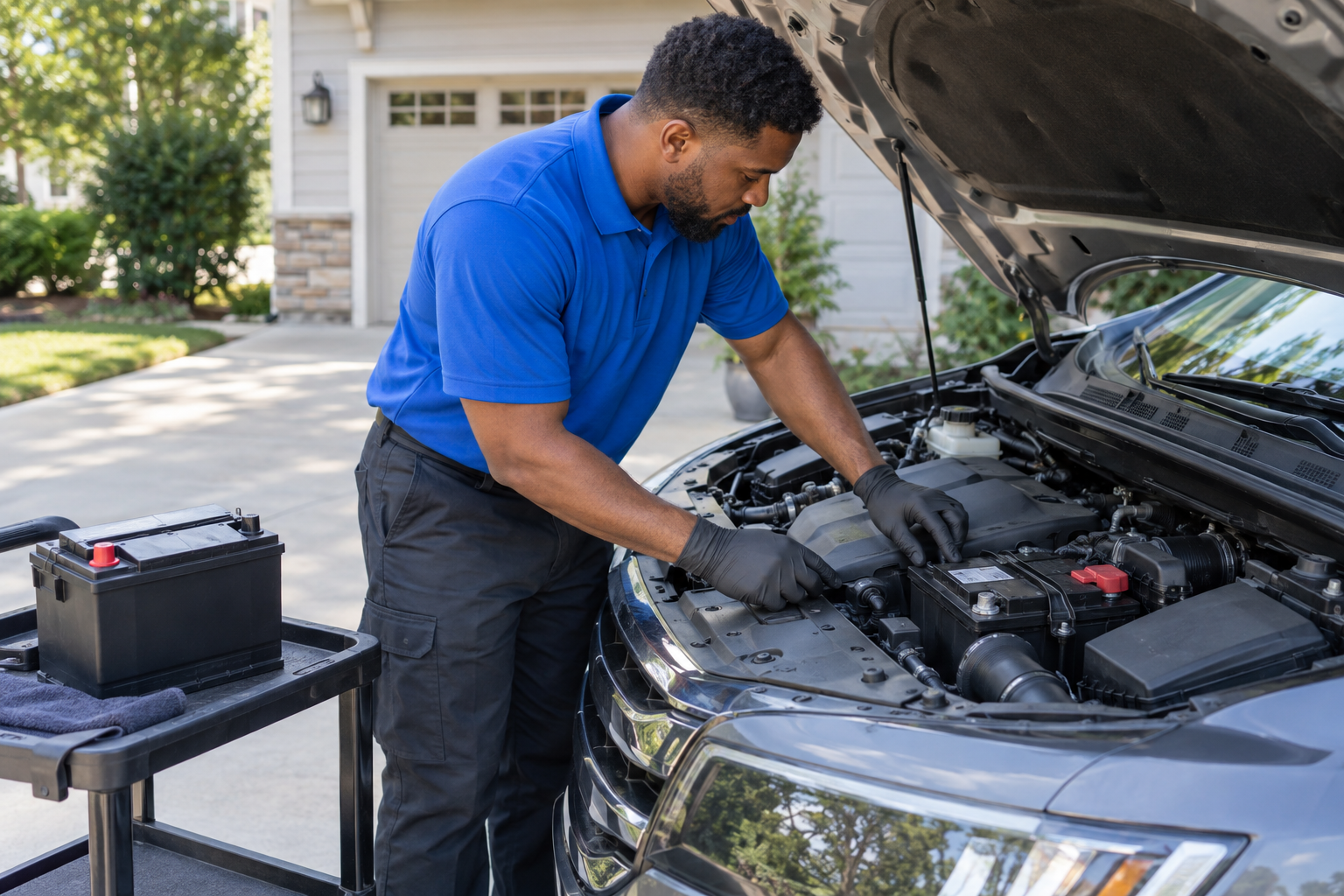
Quick answer: The correct 12-volt battery depends on the vehicle's year, make, model, engine, equipment, and manufacturer specifications. Battery group size, terminal position, battery type, and electrical rating all matter. A battery that looks close enough can still fit poorly, connect incorrectly, or fail to meet the vehicle's starting and electrical needs.
Before mobile replacement, send the exact vehicle details and a clear photo of the current battery label when it is safely accessible. Amp Rescue checks fitment and availability before dispatch rather than guessing at the roadside.
Start with the exact vehicle, not the old battery alone
The year, make, and model narrow the search, but they may not be enough. The engine, trim, start-stop equipment, and factory options can change the required battery. Two vehicles with the same model name may use different group sizes or battery types.
The owner's manual and a current battery application guide are better sources than appearance alone. A battery already installed in the vehicle may be an incorrect prior replacement, so its label is useful evidence but not the only fitment check.
What does battery group size mean?
Battery group size is more than a rough length and width. It identifies physical dimensions, the hold-down arrangement, and the terminal type and location. AAA explains that matching the original group number helps provide proper fit, clearance, cable reach, terminal alignment, and heat-shield installation.
Examples include 24F, 35, 48/H6, 94R/H7, and 49/H8. Similar-looking batteries are not automatically interchangeable. The positive terminal may be on the wrong side, the case may be too tall, or the hold-down may not secure it correctly.
Match the battery type the vehicle requires
Common 12-volt starting-battery types include conventional flooded, enhanced flooded battery (EFB), and absorbed glass mat (AGM). Vehicles with automatic start-stop systems or higher electrical demand often specify EFB or AGM, but the application guide or manufacturer information must confirm the requirement for the exact vehicle.
AAA recommends using the same battery type as the vehicle's original equipment because charging systems are designed around that type. Interstate states that an EFB replacement is intended for vehicles that require EFB and that start-stop vehicles may specify EFB or AGM. Do not downgrade an AGM or EFB application to a conventional flooded battery because it happens to fit the tray.
Check the electrical rating
Cold cranking amps, shown as CCA, measure starting output under a standardized cold-temperature test. Some vehicles specify amp-hours, shown as Ah, as well. Use a battery that meets the vehicle manufacturer's required rating.
AAA advises against installing a battery with a CCA or Ah rating below the manufacturer's recommendation. More CCA is not a reason to ignore the correct size, type, terminal layout, or manufacturer guidance.
Where to find the information
- Check the current battery label for a group number, battery type, CCA, Ah, and part number.
- Review the battery section of the owner's manual.
- Use the vehicle year, make, model, engine, and options in a reputable application guide.
- Check whether the vehicle has automatic start-stop equipment.
- Provide a clear photo of the full battery and label when it can be taken without removing covers or reaching into an unsafe area.
Do not rely on a search for the model name alone. Confirm the engine and relevant options, especially when an application guide lists more than one fit.
Some vehicles need an electronic reset or registration
Certain vehicles have battery-management systems that require a reset, adaptation, or battery registration after replacement. The procedure varies by manufacturer and model, and not every vehicle requires it. The owner's manual or manufacturer service information should be checked before installation.
If the required procedure or battery location is outside the scope of safe mobile service, the vehicle may need a qualified repair facility. Amp Rescue confirms what service is possible before dispatch.
What about hybrids and electric vehicles?
Many hybrids and electric vehicles have a separate low-voltage battery for vehicle controls and accessories. That 12-volt battery is different from the high-voltage traction battery that powers the vehicle.
Amp Rescue's battery-replacement service covers compatible standard low-voltage batteries, not high-voltage propulsion batteries. Do not touch orange cables or high-voltage components. High-voltage battery diagnosis and repair require properly trained specialists and the correct safety equipment.
Do not handle a visibly damaged battery
Step away from a battery that is cracked, leaking, badly swollen, unusually hot, smoking, or giving off a strong sulfur-like odor. Keep sparks and flames away, avoid skin or eye contact with leaking material, and call emergency services when there is immediate danger.
Battery replacement should also wait when the vehicle is exposed to moving traffic or there is not enough room to work safely. Move to a protected location when possible or arrange appropriate emergency help.
What to send Amp Rescue before mobile replacement
Send the vehicle year, make, model, engine, exact location, and what happens when you try to start it. Include photos of the current battery label and engine compartment when they are safely accessible. Mention automatic start-stop, a hybrid or electric powertrain, recent jump starts, and any battery or charging-system warning.
Also provide gate instructions, parking-deck height limits, or other access details. Dispatch checks the likely service, battery compatibility, availability, price, and expected arrival before sending a technician.
Amp Rescue provides mobile 12-volt battery replacement and jump-start service across Raleigh, North Raleigh, Durham, Wake Forest, Cary, Morrisville, Knightdale, Rolesville, Youngsville, and nearby Triangle communities.
Common questions about choosing a car battery
Can I buy a battery with the same dimensions?
Dimensions alone are not enough. The group size, hold-down, terminal position, battery type, and required electrical rating must all be correct for the vehicle.
Can I replace an AGM battery with a regular flooded battery?
Do not downgrade the battery type when the vehicle specifies AGM. Confirm the correct original-equipment type through the owner's manual or an application guide for the exact vehicle.
Is a higher CCA battery always better?
No. The battery must first have the correct fit, type, terminal arrangement, and manufacturer-required rating. A higher CCA number does not make an incompatible battery suitable.
Can Amp Rescue bring the battery to me?
Yes, when a compatible battery is available and the vehicle is safely accessible. Dispatch confirms the fitment and quote before sending a technician.
What if I cannot see the battery label?
Do not remove covers or reach into the engine bay if you cannot do so safely. Send the full vehicle details first. Dispatch can begin checking the application and ask for other information if needed.
Need the correct battery brought to your location?
Call Amp Rescue at 919-526-5165 or text us with the vehicle details, location, symptoms, and battery-label photo when available. We will confirm whether mobile battery replacement, a jump start, or another next step fits the situation before dispatch.